
How Can You Meal Prep Healthy High-Protein Meals for the Workweek?
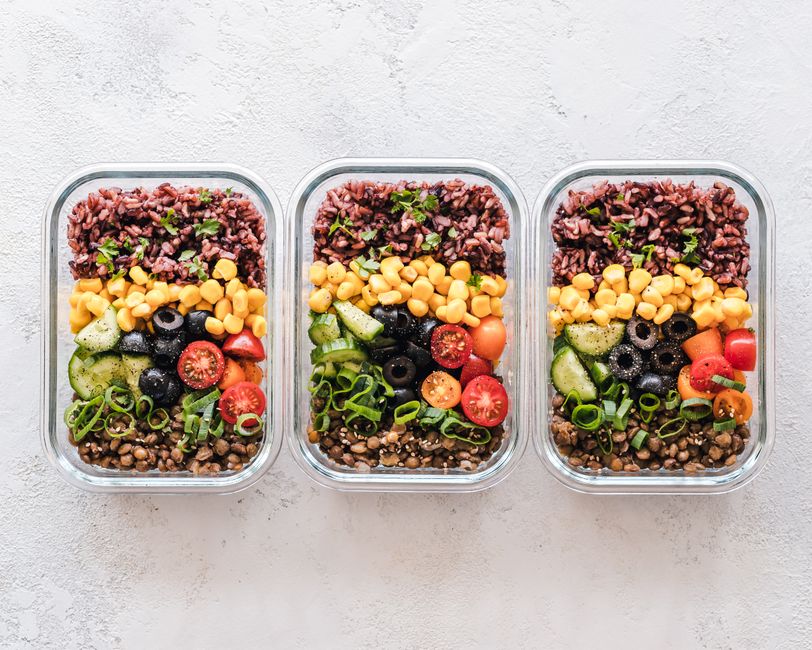
Prep a flexible bowl base with a protein, a fiber-rich carbohydrate, vegetables, and a sauce stored separately, then refrigerate only the portions you will eat within 3 to 4 days and freeze later portions. Use labels to compare protein, fiber, and sodium, reheat leftovers to 165 degrees F, and vary the sauce or vegetable finish so the same batch does not become the same lunch every day.
What are easy healthy high-protein meals to prep for the week?
The easiest approach is a four-part bowl: protein, fiber-rich carbohydrate, vegetables, and sauce. A bowl is a system, not a fixed recipe. Its value is that one batch of prepared components can become several lunches without requiring five separate cooking projects.
- Choose a protein anchor. Cook poultry to 165 degrees F, according to the USDA Food Safety and Inspection Service. For a vegetarian anchor, USDA MyPlate's black beans recipe provides 14 g of protein and 15 g of dietary fiber per serving.
- Add a fiber-rich carbohydrate. This can be the carbohydrate portion of the bowl, including brown rice when it fits your plan. The FDA Daily Value for dietary fiber is 28 g, so fiber is worth treating as a deliberate component rather than an afterthought.
- Prepare vegetables for the use case. Keep vegetables intended to be reheated separate from cold, crisp additions when possible. The goal is not culinary perfection; it is a lunch that still has contrast on a later workday.
- Separate the sauce. Portion sauce apart from the base and add it near eating or reheating time. This gives one batch multiple flavor directions and prevents every container from being committed to the same result.
For a food-based vegetarian lunch base, USDA MyPlate's black bean soup makes four servings and provides 16 g of protein and 16 g of dietary fiber in each 1 1/4-cup serving. It uses low-sodium canned black beans, vegetables, broth, salsa, and spices, and simmers for 20 to 25 minutes after the ingredients are combined. That is a useful budget pattern: repeat the inexpensive batch component, then change the surrounding bowl.
Dairy-free and lower-carbohydrate versions use the same framework. Keep the protein and vegetable components, choose the carbohydrate portion according to your preference, and check the label on sauces, broth, and canned ingredients rather than assuming they are interchangeable.
How much protein should a meal-prep lunch contain?
A meal-prep lunch should contain an amount of protein that fits your full-day needs; the FDA's general Daily Value is 50 g per day, not a mandatory per-meal target. Start by reading the grams of protein per serving and planning lunch alongside breakfast and dinner rather than treating one large lunch as the entire solution.
The reference point changes for athletes. The National Institutes of Health Office of Dietary Supplements cites recommendations of 1.2 to 2.0 g of protein per kilogram of body weight per day for athletes. That is a daily range, so it should not be converted into a universal lunch prescription.
| Label-reading checkpoint | Reference point | How to use it in meal prep |
|---|---|---|
| Protein | 50 g Daily Value | Compare the grams per serving with the rest of your day. |
| Dietary fiber | 28 g Daily Value | Pair protein with beans, vegetables, and a fiber-rich carbohydrate component. |
| Sodium | 2,300 mg Daily Value | Check sauces, canned beans, and broth before repeating them across several lunches. |
| Percent Daily Value | 20% or more is high; 5% or less is low | Use this FDA rule of thumb when the label provides a %DV. |
Distribution also deserves attention. In a 12-week trial indexed by PubMed, 26 healthy young men completed resistance training three times per week and consumed the same daily protein intake of 1.30 g per kilogram. The group with more protein at breakfast and less at dinner gained 2.5 plus or minus 0.3 kg of lean soft tissue mass, compared with 1.8 plus or minus 0.3 kg in the comparison group; the difference trended toward significance. The practical implication is modest but useful: spread food-based protein across meals instead of making dinner carry the entire plan.
Which high-protein meals do not get dry after reheating?
High-protein meals are more likely to remain appealing when you design the container around moisture control: store sauce separately, keep the protein with a moist component where appropriate, and reserve cold vegetables for after reheating. Dryness is a planning problem. A meal that is safe but unappealing is unlikely to be the lunch you choose on a busy day.
Use one batch as a set of interchangeable parts. A chicken-and-rice base can be packed with a separate sauce and vegetables added at serving. A black bean bowl can use the same beans with a different vegetable combination. Black bean soup is a useful alternative when a spoonable meal is more appealing than a reheated bowl.
There is a second distinction worth making. Variety is changing the final combination. Waste is making five unrelated meals that require separate ingredients and separate preparation. For a budget-minded plan, batch-cook the repeatable component, then use sauces and vegetables as the smaller decision layer.
How long can cooked chicken and rice meal prep stay in the fridge?
Cooked chicken-and-rice meal prep can stay in a refrigerator at 40 degrees F or below for 3 to 4 days, according to USDA Food Safety and Inspection Service guidance. A five-day workweek therefore needs a split plan: refrigerate the earlier portions and freeze the portions intended for later in the week.
| Step | USDA food-safety threshold | Practical meal-prep action |
|---|---|---|
| Cook poultry | 165 degrees F | Use a food thermometer before portioning. |
| Cool and refrigerate | Within 2 hours | Divide the batch into shallow containers so it cools quickly. |
| Room-temperature limit | 2 hours, or 1 hour above 90 degrees F | Discard perishable food held beyond the applicable limit. |
| Refrigerated leftovers | 3 to 4 days | Schedule these portions first. |
| Reheat | 165 degrees F | Measure with a food thermometer. |
The USDA states that leftovers can be kept in the refrigerator for 3 to 4 days or frozen for 3 to 4 months. Freezing later portions is not a failure of meal prep. It is the safety mechanism that lets a workweek plan extend beyond the refrigerated window. Label containers with the prep day and decide which portions are refrigerated before packing the first lunch.
The next step is concrete: choose one protein anchor, one bean-based option, one vegetable plan, and one sauce plan, then freeze the later portions before the week begins. That system reduces both repeated decisions and avoidable food-safety guesswork.
Frequently Asked Questions
How can I make high-protein meal prep without protein powder?
Use food-based components such as chicken or beans rather than relying on protein powder. USDA MyPlate's black bean soup provides 16 g of protein and 16 g of dietary fiber per 1 1/4-cup serving, while its black beans recipe provides 14 g of protein per serving. Build the rest of the meal around vegetables, a carbohydrate component if wanted, and a sauce or seasoning plan.
What are affordable high-protein meal-prep recipes?
Batch-cooked black beans and black bean soup are practical affordable options because USDA MyPlate recipes use canned low-sodium beans and make four servings. The black bean soup simmers for 20 to 25 minutes after ingredients are combined, and the black beans recipe can be paired with brown rice and a green salad. Rinsing canned beans with cold water is a USDA MyPlate recommendation for removing salt before use.
What are good vegetarian high-protein meal-prep options?
Black bean soup and black bean bowls are strong vegetarian starting points supported by USDA MyPlate recipes. A serving of the soup provides 16 g protein and 16 g fiber, while a serving of the black beans provides 14 g protein and 15 g fiber. Make several portions, then change the vegetable or sauce component across the week to create variety from the same batch.
Sources
- USDA Food Safety and Inspection Service: Leftovers and Food Safety
- U.S. Food and Drug Administration: Daily Value on the Nutrition Facts Label
- National Institutes of Health Office of Dietary Supplements: Exercise and Athletic Performance
- PubMed: Protein Distribution and Resistance Training Trial
- USDA MyPlate: Black Bean Soup
- USDA MyPlate: Black Beans
Read next

How Do I Plan a Crowd-Pleasing Buffet Menu at Home?
Plan a balanced home buffet with portions, make-ahead dishes, dietary choices, and food-safety times and temperatures.
Store-Bought Snacks That Fit Your Budget, Goals, and Commute
Use a label-and-storage system to choose satisfying store-bought snacks for budgets, dietary goals, work, cars, and travel.
How Can I Plan Cheap, Fast Weeknight Dinners?
Build a repeatable budget dinner system with pantry staples, flexible leftovers, and a small weekly prep routine.
How Can I Plan Party Appetizers for Vegetarian, Gluten-Free, and Dairy-Free Guests?
Plan one shared appetizer spread for vegetarian, gluten-free, and dairy-free guests with clear labels, safe serving, and filling options.